What it really costs to onboard a supplier by email
Email onboarding adds up in hours, waiting and risk. Here is a worksheet to put a number on all three.


On paper, an email-based vendor onboarding process costs nothing. The tools are email, a shared spreadsheet and a PDF packet that has been forwarded for years. No invoice ever arrives for any of it.
That cost shows up as staff hours, as days a new supplier can't be used, and as risk sitting in a vendor record nobody checked twice. This post gives you a simple worksheet to price each one, so you can talk to finance with your own figures.
A top-10 foodservice distributor walked us through its process. Getting a new supplier from signed agreement to final buyer approval typically took two to three weeks. Procurement spent the first week or two collecting company details, contacts, agreements and product information through emails, calls and document requests. Then quality assurance, food safety, finance, accounts payable and supply chain each reviewed the submissions and went back and forth with the supplier, and with each other, over missing information and approvals. Only after final approval did master data staff create the vendor and item records in the ERP.
Why does onboarding by email feel free?
Because nobody gets billed for it. The work is spread across a requester who wants the supplier, a buyer who sends the packet, someone in accounts payable (AP) who sets up the vendor record, and sometimes a compliance reviewer. Each spends twenty minutes here and there, and none of it lands in one budget line.
Email also hides the waiting. A supplier who returns a W-9 (the form US companies use to collect a supplier's taxpayer ID for the Internal Revenue Service, the US tax authority) without a signature costs one reply and a few days. Nobody logs those days anywhere.
How long does the vendor onboarding process take?
There is no single benchmark, and the ones that exist measure different things. APQC, a benchmarking nonprofit, puts the median time to set up a supplier in the procurement system at 3.0 days across more than 3,000 organizations. That covers only the setup step inside the system.
The whole path takes much longer. The Institute for Supply Management (ISM), the main US professional body for procurement, notes there is no consensus benchmark, and cites IBM's average of about 30 days to onboard a new supplier, with up to six months at many large companies. Much of the gap between those two numbers is time spent waiting for documents, answers and approvals.
What goes into the real cost?
There are three buckets. Staff time, delay and risk. Staff time is the easiest to count, so it's a good place to start.
Staff time. Every touch has a person behind it. Someone sends the packet, answers the supplier's questions, chases missing documents, reviews what comes back, keys the data into the ERP (the enterprise resource planning system that holds your vendor master) and calls to confirm bank details.
Delay. Every day a supplier sits in onboarding is a day you can't buy from them. When it's a replacement supplier during a shortage, or a new item a category manager has already promised a customer, two weeks of waiting has a price.
Risk. The US Federal Bureau of Investigation's (FBI) Internet Crime Complaint Center (IC3) received 24,768 business email compromise complaints in 2025, with reported losses of about $3 billion. The FBI describes the scheme as one that targets businesses working with suppliers. A bank letter sent as a PDF and keyed in by hand is exactly the opening these schemes look for.
The distributor I mentioned counted staff time and risk as costs. It didn't measure delay, and that's the gap I see most often in these conversations. The real cost includes the value lost while an item waits to be sold, and the exposure when the information that finally arrives is incomplete or wrong.
A worksheet you can fill in this week
Here is a simple worksheet. The minutes below are an illustrative example for a mid-size distributor. Replace them with your own.
| Step | Minutes per supplier |
|---|---|
| Send the packet and answer first questions | 20 |
| Chase missing or incorrect documents (about four follow-ups) | 40 |
| Review the W-9, certificate of insurance and bank letter | 30 |
| Key the record into the ERP and fix errors | 20 |
| Call back to verify bank details | 15 |
| Route approvals and answer status questions from the requester | 25 |
| Total | 150 |
Now price the time. The US Bureau of Labor Statistics (BLS) reports a median annual wage of $77,710 for buyers and purchasing agents in May 2025, or about $37 an hour. For private industry employers, wages make up 70% of total compensation in BLS employer cost data for June 2026, so our estimate for a fully loaded hour is about $53.
At 150 minutes, one supplier costs about $133 in staff time. A team onboarding 200 suppliers a year spends about $26,700, before anyone counts delay or risk. Extra reviewers or resubmissions push it higher.
Delay is usually the bigger number. Say a new item is expected to sell $5,000 a week at a 25% contribution margin. Every week it waits in onboarding costs about $1,250 in margin, so three weeks costs $3,750. That one item's wait costs more than the staff time for 28 suppliers. To price your own, count the calendar days from request to first purchase order for your last ten suppliers, and ask each requester what the item was expected to sell.
For risk, start with your own controls. How many vendor bank changes did you process last year, and how many were confirmed by calling a number you already had on file?
Where do the hours actually go?
In the worksheet above, chasing is the biggest line. A supplier rep fills out half the packet, sends it from a phone, and the follow-up loop starts. Each reply takes a few minutes and pushes the finish line back a day or two.
Review is the second hidden cost. Someone has to open the certificate of insurance and check the limits and dates against what you require, then check that the W-9 name matches the bank letter. When that review happens at the end, every error found means another round of emails.
How do teams bring the cost down?
Three changes take most of this cost out.
- The supplier enters their own data in one guided place. There is no packet to chase and nothing to retype.
- Documents are checked as they arrive. A missing signature or an expired certificate goes back to the supplier with the reason within minutes.
- Every decision stays on the record. Who approved the supplier, what was checked and when the bank details were verified all sit on the supplier's record.
Alex Masalov, our Head of Engineering, explains why checking supplier bank details once at onboarding isn't enough.
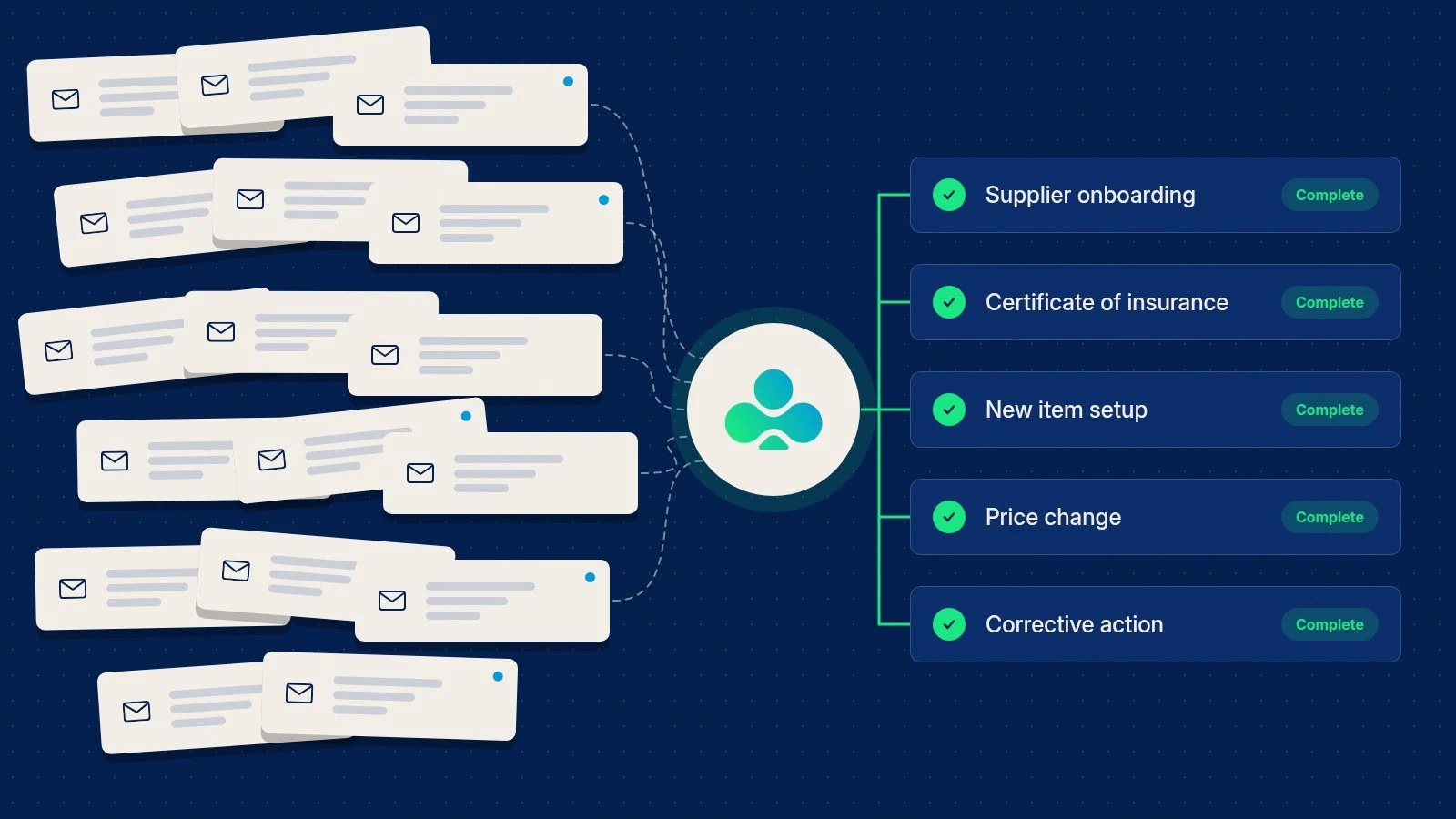
This is how supplier onboarding works in Clover. The supplier gets one guided task, document collection checks each file at upload, and the approved details land in a supplier record that syncs to your ERP.
What one number should you measure this month?
Lost contribution margin from onboarding delays. For a foodservice distributor, setting up a new supplier can drag on anywhere from five business days to three full weeks while procurement chases insurance forms, accounting fixes incorrect banking information and sign-offs sit in inboxes. Labor totals only count processing hours. The margin you didn't earn while the item sat on the sidelines is the bigger number, and the one finance will notice.
To get there, run the worksheet on your last ten suppliers, add the delay cost for each, and share the total with finance.
Frequently asked questions
What is the vendor onboarding process? It is the set of steps that takes a new supplier from request to ready to buy from. It usually covers collecting tax, banking and insurance documents, checking them, approving the supplier and creating the vendor record in the ERP.
How long does the vendor onboarding process take? It depends on what you measure. APQC's median for setting a supplier up in the procurement system is 3.0 days, while the full process commonly takes about a month, and up to six months at many large companies, according to the Institute for Supply Management.
How do you calculate the cost of onboarding a supplier? Add up the minutes each person spends per supplier, multiply by a fully loaded hourly rate, then multiply by the number of suppliers you onboard each year. Then add the margin lost to delay and the exposure from unverified bank details.
See what onboarding looks like when suppliers do the data entry. Book a demo

 Alex Masalov
 Josh McBride

 Shawn Cady