What is an 8D report? Supplier corrective actions explained
An 8D report shows how a supplier found and fixed a quality problem. Here is how the method works, where it came from, and what buyers should ask for.


An 8D report is the written record of how a supplier solved a quality problem using eight disciplines, from forming a team to preventing the problem from coming back. Buyers often ask for one through a supplier corrective action request (SCAR) when a defect reaches them, and a good one shows whether the fix actually worked.
I've spent most of my career on the data that moves between buyers and suppliers, and corrective actions are where that data gets tested hardest. The method itself is sound. What goes wrong is usually what happens to the information along the way.
Where did the 8D method come from?
8D grew up in the auto industry. Ford Motor Company first published it in 1987, in its Team Oriented Problem Solving manual, and in the 1990s a ninth step, D0, was added at the front, according to AllAboutLean. ASQ, the American Society for Quality, still describes 8D as common in automotive, and it has since been applied in healthcare, retail, finance and government.
What are the eight disciplines?
ASQ names nine steps, starting with the planning step. The notes after each name are mine.
- D0. Plan. Decide how to tackle the problem and what has to happen right away.
- D1. Establish a team. People who know the product and the process, on both sides.
- D2. Define and describe the problem. What failed, where, how many, since when.
- D3. Develop and execute an interim containment plan. Protect the customer while the real cause is found.
- D4. Determine and verify root causes. Include why the defect escaped the supplier's own checks.
- D5. Choose and verify permanent corrections. Prove the fix works before rolling it out.
- D6. Implement and validate corrective actions. Confirm the fix works in production, then lift the temporary containment.
- D7. Take preventive measures. Update the process, the controls and similar parts.
- D8. Congratulate your team. Close it out and recognize the people who solved it.
ASQ says the steps should run in sequence. That order matters, because each discipline depends on evidence from the one before it.
What does a corrective action look like in practice?
8D was built for factories, but most companies that buy from suppliers run a broken version of it under other names. I've watched it most in food distribution and retail. The same loop shows up across industries.
A customer or an internal team reports a problem. The shipment came in short, the label was wrong, the product arrived damaged. The buyer makes it right with the customer or internal stakeholders first, then claims the cost back from the supplier, and maybe someone in purchasing or quality sends a note. What comes back, if anything, is an email saying the issue has been addressed, or a PDF with a few boxes filled in. Someone changes a status from open to closed, and the loop ends.
The data from that loop ends up scattered. The complaint lives in one system with a reason code. The claim against the supplier lives in accounts payable. The note to the supplier sits in one inbox and the supplier's response in another, as an attachment. The fix, if there was one, lives in the supplier's head.
The incident counts exist, so most buyers can tell you which five suppliers caused the most problems this quarter. What nobody can see is what each supplier said the previous eleven times, or whether anything changed. The record of what each supplier did about a problem is the part that goes missing.
Safety problems are the exception. When a problem could hurt someone, or an auditor is going to ask, companies run something close to the full method. For everything an auditor won't ask about, which is nearly all of the volume, the loop stops once the cost of the error is recovered, and the cause behind it goes unfixed.
Why do so many 8D reports fail to stop the problem?
Two things, and both come down to missing data.
The first is on the buyer's side, and nobody wants to own it. The problem description is thin. "Product arrived damaged," with no lot, no quantity, no photo and no date received. The buyer sends that to the supplier and expects a root cause. The supplier can't find the root cause of a problem that was never described, so they write something plausible, and the buyer accepts it because they don't have the data to argue. Describing the problem clearly (D2 in the 8D method) is the buyer's job, and the buyer skips it.
The second is that "done" means "submitted." The supplier sends the form, the buyer files it, the case closes. Outside a safety incident, nobody goes back in sixty days to see if the problem stopped. The 8D method has a whole step for verifying the fix, but for routine quality and service issues, few companies run it.
Under both sits the form itself. A PDF is filled in once and sent, so it can't track a problem that is contained but whose cause is still unknown. It can't flag that a supplier's last four root causes were all "operator retrained," and it can't be searched across a thousand suppliers to find the one problem that's actually systemic. So suppliers fill in all eight steps at once, after the fact, and the finished report reads as if each step was done when it may not have been. The form ends up standing in for the work it was meant to record.
What should a buyer ask suppliers to send?
Ask for a process with states, one the corrective action moves through until the fix is verified.
A corrective action should have structured fields, an owner on each side, a status that can say "contained but not root-caused," and a verification step that won't let it close until somebody confirms the problem has stopped. The eight disciplines already describe that shape. The industry flattened them into a form because a form is what email can carry.
In practice, each discipline should produce something you can check and keep.
- D2. Part numbers, lots and quantities affected, with dates and photos.
- D3. What was contained, where, and how much suspect stock was sorted or held.
- D4. The root cause and the escape point, with the evidence behind both.
- D5 and D6. Proof the correction works, such as inspection results after the change.
- D7. Which documents, controls and similar parts were updated.
Once the data is structured, the corrective action sits next to the incident counts you already have, so the twelfth complaint about the same supplier shows up next to what they promised after the eleventh. AI also becomes useful at the two points people are worst at. At the front, it can turn a two-sentence complaint into a problem statement a supplier can actually work. At the root cause step, it can flag a non-answer before the buyer accepts it.
How does this work in a system?
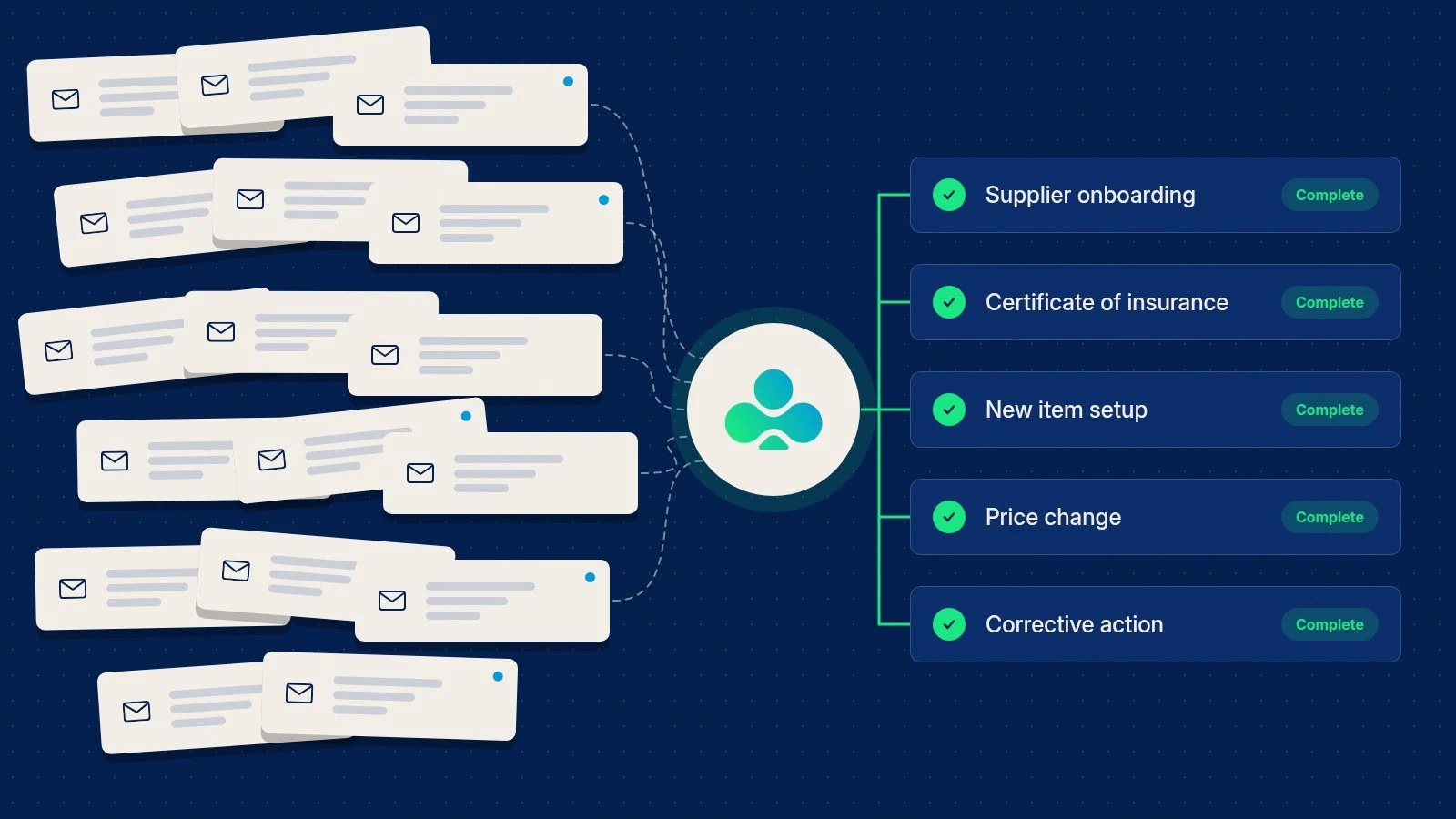
That is the approach behind supplier corrective actions in Clover. Each SCAR runs as a workflow with required steps for root cause, corrective plan and evidence, deadlines and reminders, and a reviewer who verifies the fix before it closes. Past corrective actions stay on the supplier's record, so a repeat problem shows up as a failed fix, and a serious incident can trigger a fresh supplier assessment.
For the bigger picture of why supplier work needs its own system, read the work between you and your suppliers deserves its own system.
Frequently asked questions
What does 8D stand for? 8D stands for eight disciplines, the eight steps of a structured problem solving method that Ford documented in 1987. A ninth step, D0, was added in the 1990s for planning and emergency response.
What is the difference between a SCAR and an 8D report? A SCAR is the buyer's request that a supplier investigate and fix a problem. The 8D report is the supplier's answer, showing containment, root cause, the permanent fix and how recurrence will be prevented.
Is 8D only used in the auto industry? It started in automotive, and ASQ notes it has also been applied in healthcare, retail, finance, government and manufacturing. It suits problems whose root cause isn't obvious or that span several departments.
See how Clover runs supplier corrective actions to verified closure. Book a demo
 Josh McBride